The Medical Seat Bubble: How India’s PG Explosion is Diluting the Elite Doctor
An objective, data-driven economic analysis of how credential inflation and the mass expansion of postgraduate medical seats are creating a structural saturation of specialist doctors in India.
Author's Note: This article is an objective, mathematical, and data-driven economic exercise. It is not intended to offend, degrade, or downplay any individual, institution, or profession. The overwhelming majority of students and residents in these disciplines undergo immense psychological, emotional, and physical hardship during their training, making massive personal sacrifices to earn their qualifications. While systemic nuances exist (such as private/deemed university management quotas or seat purchases), the operational baseline of a residency remains grueling and demanding. The focus here is strictly on supply-and-demand economics, structural scarcity versus mass production, and the micro-level career friction facing first-generation specialists. The numbers presented herein have not been independently verified but are drawn from reliable official matrices and registries, reflecting the broad economic realities of the sector.
For decades, securing a medical specialization in India (MD/MS/DM/MCh) was an absolute guarantee of instant generational wealth and apex social prestige. This guarantee was rooted not just in the rigor of the training, but in hyper-scarcity. However, a macroeconomic transition is fundamentally reshaping the landscape. To truly understand this shift, we must analyze the landscape discipline by discipline. The fundamental economics of supply and demand dictate that the demand for medical services in any given geography is finite. The exponential wealth and prestige associated with the surgeons of yesteryears required absolute scarcity to play out—historically, there was often only 1 specialist surgeon for a significant population of hundreds of thousands. As the National Medical Commission (NMC) aggressively scales medical education pipelines, this scarcity-driven wealth and prestige is likely to nosedive exponentially. Furthermore, the government’s current outlook and aggressive public policy mandate ensure that this seat explosion will continue unabated.
According to official parliamentary updates from the Ministry of State for Health and Family Welfare, medical colleges have more than doubled from 387 in 2014 to 844, expanding undergraduate capacity to 139,489 seats, while total PG seats skyrocketed from 31,185 to 86,360. This expansion is part of the Union Cabinet's long-term mandate, documented via the Press Information Bureau, aiming to inject an additional 75,000 medical seats into the country within a 5-year vision block. The core consequence of this policy is rapid credential inflation and the destruction of the geographic scarcity advantages that previous generations of specialists enjoyed.
Historical Baseline: The Hockey-Stick Growth (2010 vs. Present)
To contextualize the credential inflation, we must compare the late 2000s and early 2010s with the present-day landscape. In 2010, the entire country had roughly 17,294 postgraduate medical seats, according to historical data from the Hindustan Times. Today, that number has surged past 86,360. The practicing pool across key surgical disciplines has exhibited true "hockey-stick" exponential growth over the last decade.
| Discipline / Metric | Circa 2010 Estimated Pool | Present Day (2025-2026) | Approximate Growth |
|---|---|---|---|
| Total PG Medical Seats | ~17,294 | 86,360 | ~400% |
| Gastroenterology | ~350 (ResearchGate) | 4,571 | ~1,206% |
| Neurosurgery | ~2,500 (NIH) | ~4,500 | ~80% |
| Ophthalmology | ~11,000 (Sightsavers) | 20,944 | ~90% |
| Orthopaedics | ~8,000 (IOA trend est.) | ~20,000 | ~150% |
Visualizing the Supply Shock (Total PG Seats)
- 2010:
[███ ] 17,294 - 2014:
[██████ ] 31,185 - 2018:
[████████ ] ~38,000 - 2022:
[████████████ ] ~60,000 - 2026:
[████████████████████] 86,360
The Denominator Trap: Calculating the True Addressable Market
When evaluating specialist saturation, we must first define the true addressable market. While India boasts a population of over 1.4 billion, the vast majority lack the financial wherewithal or comprehensive private insurance to afford independent specialist care, relying instead on subsidized public healthcare (where government package rates are often too low to sustain standalone private practices). The actual "paying population"—the middle-to-upper class driving corporate and private independent demand—is estimated at roughly 15%, or approximately 200 million people. Compounding this issue is demographic reality: the Total Fertility Rate (TFR) of this urban paying class is rapidly dropping. This means the paying population denominator will effectively stagnate or shrink over the next decade. Therefore, to understand true market saturation, we must calculate the compounding specialist density against this stagnant 200 million denominator.
The Raw Percentage Explosion Across Core Specializations
The actual practicing pool of specialists is expanding in raw percentage terms at an unprecedented velocity, creating a massive demographic bulge of young surgeons and physicians. An analysis of the specific metrics across major fields highlights this shift.
1. Orthopaedics
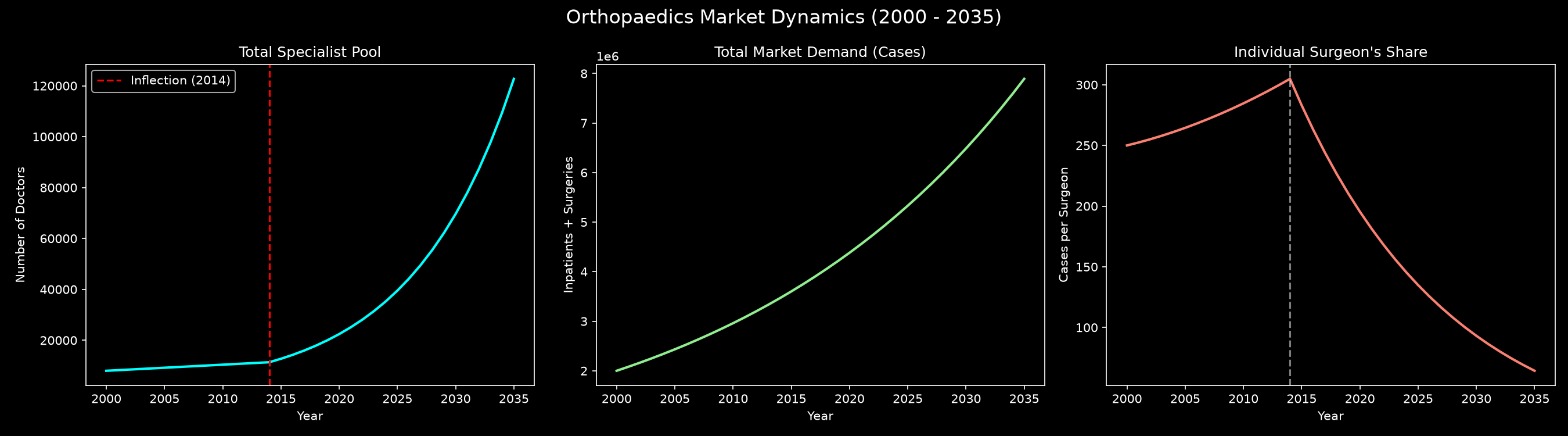
The baseline NMC MS Orthopaedics Seat Matrix confirms 3,656 seats nationwide. When aggregating DNB Orthopaedics and state diplomas, the annual influx stands at 4,500 to 5,000 new surgeons. Historical data published in the NCBI / PMC Orthopaedic Education Review noted a base of ~20,000 practicing orthopedic surgeons. Adding ~4,500 new surgeons to a base of ~20,000 means the practicing pool is expanding by a staggering 22.5% in raw percentage terms in a single year. Assuming a standard 30-year active career lifespan, only 2.5% of the base (500 surgeons) retire or pass away each year. The net annual addition of over 4,000 surgeons vastly oversupplies the replacement demand.
| US Recommended Benchmark (per 100K) | Indian Paying Pop. Denominator | Current Ratio (per 100K paying pop.) | Projected Ratio in 5 Years | Projected Ratio in 10 Years |
|---|---|---|---|---|
| 9.25 | 200 Million (Stagnant) | 10.0 | 20.0 (Pool: ~40,000) | 32.5 (Pool: ~65,000) |
From a demand perspective, statistics indicate that approximately 5.68 million orthopaedic procedures were performed in India in 2022, with the market growing at a Compound Annual Growth Rate (CAGR) of 7.4% to 7.9%. If we conservatively estimate that there are roughly 25 million to 30 million outpatient orthopaedic consultations annually, this modicum of finite demand is being heavily diluted.
Furthermore, this demand pool is actively shrinking at the entry-level. Routine musculoskeletal issues, sprains, and minor pains are increasingly managed by patients themselves utilizing AI diagnostics and Google searches. Simultaneously, there is a massive influx of local, non-specialized general practitioners (MBBS) and alternative medicine practitioners who comfortably capture and manage basic pain relief, casting, and minor trauma before a patient ever reaches a specialist.
Because the surgical workload is limited and the entry-level consultation pool is highly fractured, the exploding supply of 4,500+ new surgeons annually will brutally suppress earnings and prestige. What was once a ratio of 1 elite surgeon commanding an entire district of 500,000 people is rapidly shrinking toward 1 surgeon per 10,000 or less in urban clusters. This saturation forces young surgeons into cut-throat competition, localized price wars, and indefinite reliance on low-paying corporate hospital shifts, permanently destroying the hyper-lucrative private practice model of yesteryears.
2. Ophthalmology
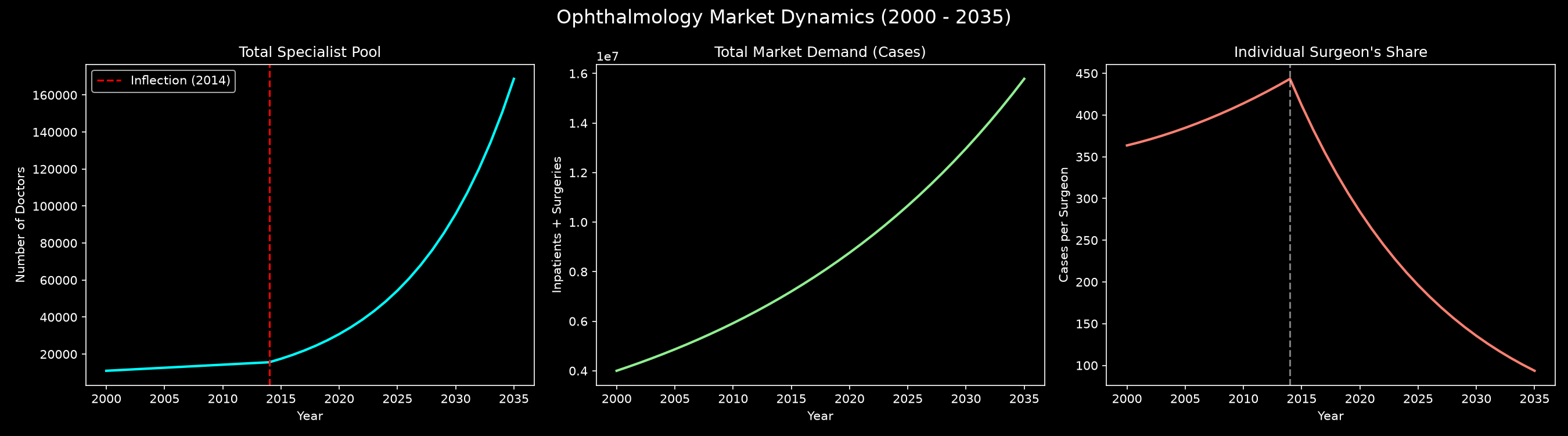
The NMC PG Seat Matrix accounts for 2,479 MS Ophthalmology seats. Factoring in DNB and fellowships brings the yearly influx to 3,200 to 3,500. An AIIMS Delhi Nationwide Survey reported by The Hindu registered 20,944 practicing ophthalmologists at secondary and tertiary levels. An annual influx of ~3,300 against a base of ~21,000 represents a blistering ~15.7% annual growth rate in the practicing pool.
| US Recommended Benchmark (per 100K) | Indian Paying Pop. Denominator | Current Ratio (per 100K paying pop.) | Projected Ratio in 5 Years | Projected Ratio in 10 Years |
|---|---|---|---|---|
| 5.70 | 200 Million (Stagnant) | 10.5 | 18.0 (Pool: ~36,000) | 27.0 (Pool: ~54,000) |
From a demand perspective, India performs approximately 7 million to 8 million cataract surgeries annually, with market growth estimates ranging from 4.4% to 10.3%. We can extrapolate an outpatient demand pool of roughly 40 million to 50 million routine consultations.
However, just like in orthopaedics, this entry-level demand is being aggressively siphoned. Routine refractions, conjunctivitis, and basic eye care are increasingly absorbed by massive corporate optometry chains (like Lenskart or Titan EyePlus), localized MBBS doctors, and patients turning to internet self-diagnosis for minor ocular allergies.
Despite the high volume of surgical targets, the workload is heavily consolidated. Massive corporate eye-care chains dominate the landscape, utilizing high-volume, cut-rate surgical assembly lines. Because patients no longer rely on standalone clinics for cataract procedures, individual new entrants are locked out of private surgical market capture. The ratio of ophthalmologists is dropping rapidly, plunging from 1 specialist per 100,000 people to saturation levels of 1 per 10,000 in urban zones. This hyper-competition suppresses independent practice viability and strips away the elite prestige formerly associated with the specialty, turning many young surgeons into highly qualified corporate technicians.
3. Otorhinolaryngology (ENT)
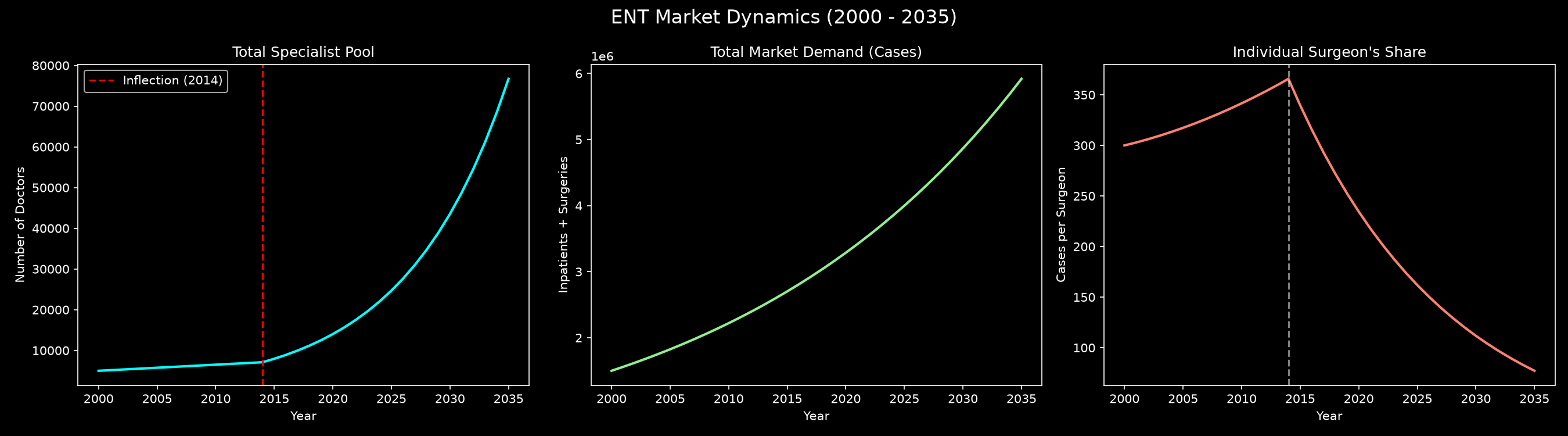
The NMC seat matrix yields an annual output of 1,500 to 1,800 ENT specialists nationwide. The practicing base is estimated at approximately 10,000 to 12,000 across India. A yearly injection of ~1,600 specialists into a base of 11,000 represents an annual compounding expansion of ~14.5%.
| US Recommended Benchmark (per 100K) | Indian Paying Pop. Denominator | Current Ratio (per 100K paying pop.) | Projected Ratio in 5 Years | Projected Ratio in 10 Years |
|---|---|---|---|---|
| 3.36 | 200 Million (Stagnant) | 5.5 | 9.25 (Pool: ~18,500) | 13.75 (Pool: ~27,500) |
While the ENT devices market is projected to grow at a CAGR of 7.9% to 8.5%, the actual volume of high-end surgeries is relatively small compared to the sheer output of specialists. Basic elective procedures, such as tympanoplasties and tonsillectomies, constitute the bulk of the surgical demand.
Critically, the entry-level consultation pool for ENT is heavily eroded. Millions of cases of allergic rhinitis, basic otitis media (ear infections), and sinusitis are managed entirely by patients utilizing Google searches, over-the-counter antihistamines, or by neighborhood general practitioners and pediatricians. By the time a patient's condition necessitates a specialist's intervention, they are fiercely competed for.
Establishing an independent practice is increasingly constrained by an absolute reliance on localized GP referral networks. Because the supply of ENT surgeons is expanding by nearly 15% every single year, these referral networks are notoriously difficult for new specialists to penetrate. The loss of the entry-level patient pool combined with limited surgical volume inevitably pushes new ENT graduates into price wars and destroys the traditional pathway to independent wealth.
4. Neurology & Neurosurgery (Super-Specialties)
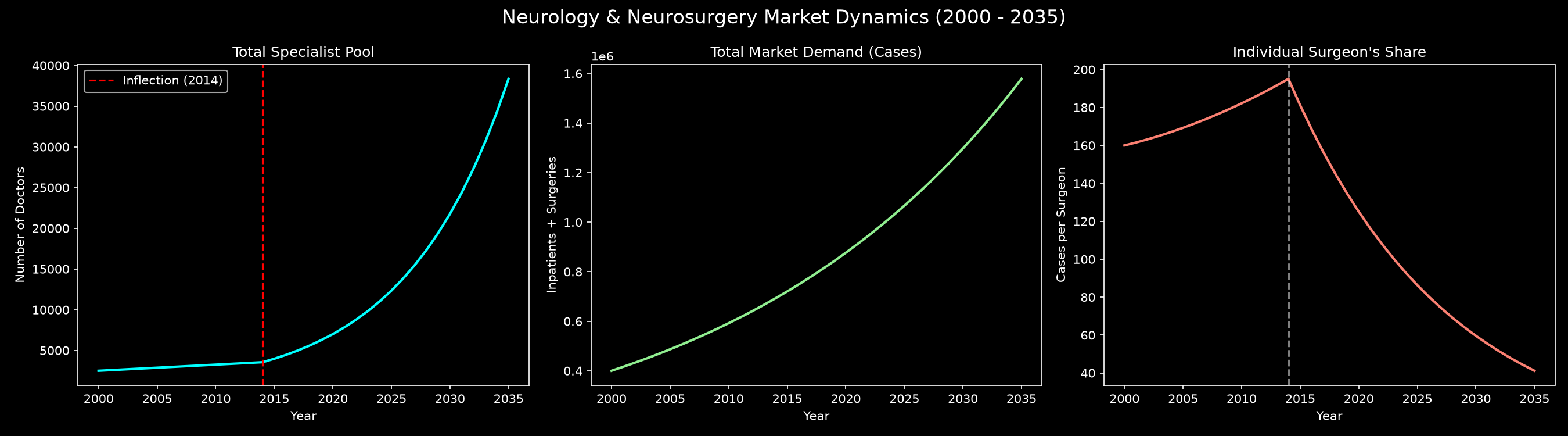
The NMC NEET-SS Seat Matrix reveals that super-specialty paths inject 800 to 1,000 new brain and spine specialists into the ecosystem every single year. This practicing base was historically small and hyper-elite, with total practicing neurosurgeons across the nation estimated between 3,500 and 4,500. Infusing ~900 super-specialists into a modest base of ~4,000 means the hyper-elite practicing tier is expanding by an astronomical 22.5% in raw percentage terms annually.
| US Recommended Benchmark (per 100K) | Indian Paying Pop. Denominator | Current Ratio (per 100K paying pop.) | Projected Ratio in 5 Years | Projected Ratio in 10 Years |
|---|---|---|---|---|
| 1.58 | 200 Million (Stagnant) | 2.25 | 4.50 (Pool: ~9,000) | 7.25 (Pool: ~14,500) |
Industry reports indicate India records roughly 102,500 neuro-procedures annually, driven by 1.8 million new stroke cases and 40,000 to 50,000 brain tumor diagnoses. While the market CAGR is projected at an aggressive 25%, the micro-economics for individual surgeons are deteriorating.
At the consultation level, basic headaches, mild migraines, and chronic lower back pain are routinely managed by general physicians, AI symptom checkers, or physiotherapists, filtering out lucrative, low-risk OPD volume.
The most devastating factor for neurosurgeons is the "capital trap." Because they cannot set up individual standalone neuro-ICUs or purchase multi-million dollar neuronavigation systems, these ~900 fresh super-specialists are forced to cluster entirely inside tier-1 corporate hospital panels. This creates an extreme, hyper-localized oversupply in urban centers. A decade ago, a neurosurgeon dictated terms to the hospital; today, because there are dozens of equally qualified surgeons vying for the same operational theater time, the corporate hospitals dictate terms, systematically destroying junior bargaining power and the apex prestige of the field.
5. Gastroenterology (Medical & Surgical)
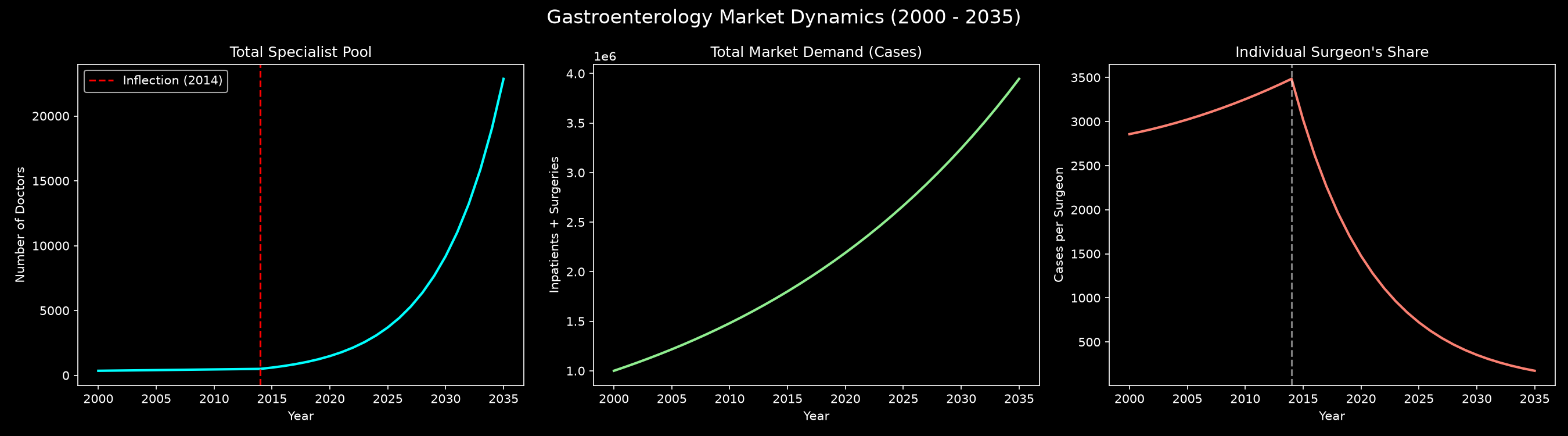
The annual graduate pipeline adds 500 to 600 gastroenterology specialists per year. Live healthcare directories confirm that there are currently 4,571 verified gastroenterologists practicing across India. Pushing 550 new gastroenterologists annually into a verified pool of 4,571 results in a massive ~12% annual expansion in raw percentage terms.
| US Recommended Benchmark (per 100K) | Indian Paying Pop. Denominator | Current Ratio (per 100K paying pop.) | Projected Ratio in 5 Years | Projected Ratio in 10 Years |
|---|---|---|---|---|
| 3.90 | 200 Million (Stagnant) | 2.30 | 3.68 (Pool: ~7,300) | 5.43 (Pool: ~10,800) |
From a demand standpoint, reports estimate over 2.88 million endoscopic procedures are performed annually in India, including roughly 237,088 ERCP/PTC procedures. While the overall market is expanding, the individual surgeon's share of that market is shrinking rapidly.
The entry-level OPD demand—cases of basic acid reflux, GERD, and IBS—is increasingly captured by general practitioners or by patients self-medicating with over-the-counter antacids following a quick Google search.
Similar to neurosurgery, gastroenterology relies entirely on high-end interventional diagnostics, such as ERCP, Endoscopic Ultrasound (EUS), and high-definition colonoscopy suites. A fresh graduate cannot practice independently without access to these multi-crore rupee setups. This economic reality effectively forces the massive annual influx of 550+ specialists onto the payrolls of consolidated corporate tertiary care networks. Stripped of the ability to open low-overhead standalone practices, new gastroenterologists face immediate corporate subjugation, severely dampening the prospect of independent practice and generational wealth that earlier cohorts enjoyed.
A Critical Caveat: The Power-Law Dynamics of Medicine
It is important to note that the sheer expansion of numbers does not perfectly distribute demand. Medicine is fundamentally power-law driven. Even as the volume of new specialists skyrockets and individual shares of demand shrink across the board, a highly localized fraction of elite, established surgeons—or uniquely branded modern "super-surgeons"—will continue to monopolize a massive chunk of the surgical demand pile.
Because healthcare outcomes carry such high risk, patients intrinsically herd towards proven brands. This means that while 80% of the new, struggling supply may fight over 20% of the fragmented outpatient demand, the top 20% of entrenched surgeons will retain nearly 80% of the high-value surgical market capture. The seat bubble does not necessarily destroy the apex surgeon; rather, it exponentially raises the barrier to entry, transforming what was once a guaranteed outcome for all graduates into a hyper-competitive tournament where the vast majority of new specialists end up as corporate laborers rather than independent titans.